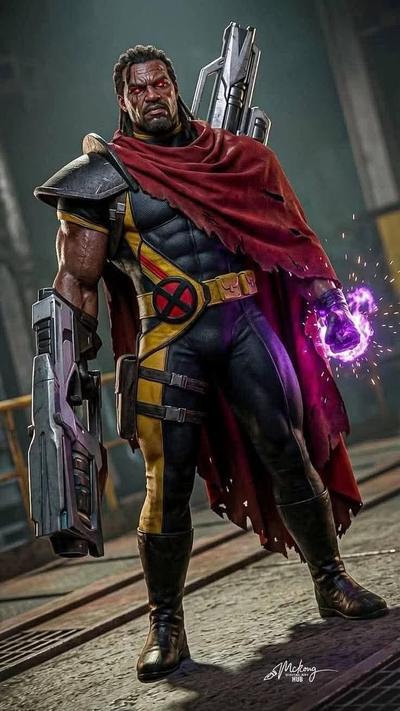
Character profile

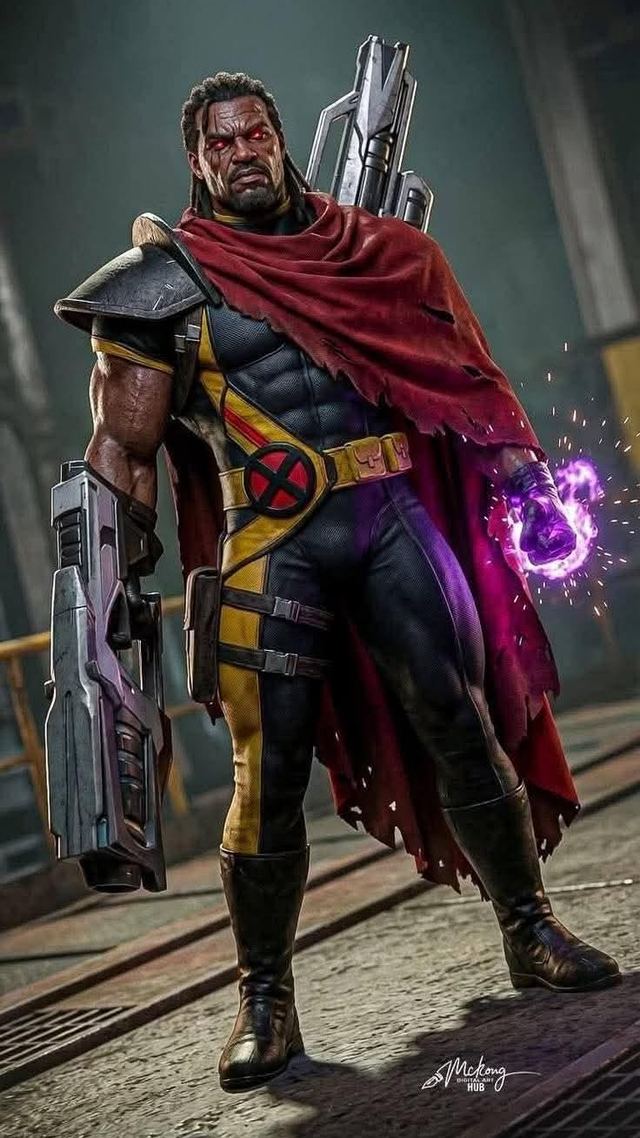
Bishop

Lucas Bishop

A cop from the end of the world, trying to arrest the future.

Bishop poster art

Biography

Lucas Bishop was born in a camp, with an M branded over his eye so nobody could mistake what he was. His future is the one the X-Men failed to prevent: Sentinels, ash, mutants processed and tagged. Bishop grew up on stories of Xavier's dream and on one poisonous piece of history — that the X-Men were destroyed from the inside by a traitor. He became an XSE officer, then followed that trail back through time to the present day to make an arrest, arriving as a heavily armed stranger who suspected everyone in the mansion.

The paranoia eventually ate him. When Hope Summers was born during Messiah Complex, Bishop recognised her as the child his history blamed for the camps, and he chased her across centuries with a gun — killing, burning bridges and detonating his own future to reach an infant. It is one of the most complete hero-to-villain falls Marvel has published, and the climb back took years of prison and penance. By the Krakoa era he was riding with Kate Pryde's Marauders, doing the unglamorous work of getting mutants home alive.

Vital statistics

Real name
Lucas Bishop
Also known as
Bishop, XSE Officer Bishop
Species
Mutant
Place of origin
A mutant internment camp in a dystopian future
First appearance
Uncanny X-Men #282 (November 1991)
Created by
Whilce Portacio, John Byrne
Affiliations
X-Men, Xavier's Security Enforcers, X-Treme X-Men, Marauders

Power grid

Intelligence4
Strength3
Speed3
Durability4
Energy6
Fighting5

Rated 1–7 on the classic Marvel power-grid scale.

Powers

  • Energy Absorption

    He soaks up energy directed at him — plasma, electricity, optic blasts — instead of being hurt by it.

  • Energy Redirection

    Whatever he absorbs comes back out of his hands as concussive force, usually at the person who fired it.

  • Absorptive Durability

    Channelled energy toughens his body, letting him walk through fire that would kill most mutants.

  • Energy Reserves

    He banks absorbed power for later, which means he can walk into a fight already loaded.

  • Temporal Displacement

    Future technology and hard experience let him move between eras and survive the trip.

Abilities

  • XSE-trained law enforcement officer and investigator
  • Expert marksman with both future and contemporary weapons
  • Hardened close-quarters combatant
  • Encyclopaedic knowledge of X-Men history — read backwards, from its ending

Weaknesses

  • Absorbing more energy than he can store or vent injures him badly
  • Nearly useless against purely physical attacks he cannot absorb
  • Rigid faith in the history he was taught as a child
  • That history is partial, edited and frequently wrong

Comics history

Bishop landed at exactly the right moment: a Jim Lee-era X-Men rebuild that needed a new-blood breakout, dropped into the middle of the franchise's shift from Australia to the Blue and Gold teams. Whilce Portacio and John Byrne gave him the coat, the shoulder cannon and a mystery — who is the traitor? — that Marvel milked for most of the decade. He anchored X-Treme X-Men alongside Storm, turned antagonist for Messiah Complex, and returned in the Krakoa era on the Marauders. His real innovation was structural: Bishop made the X-Men's future a permanent character in the line.

Allies

  • Storm
  • Kate Pryde
  • Shard
  • Professor X
  • Cable

Enemies

  • Trevor Fitzroy
  • Bastion
  • Stryfe
  • Sentinels

Weapons & equipment

  • XSE-issue plasma rifle
  • Shoulder-mounted cannon
  • XSE badge
  • Reinforced body armour

Trivia

  • The M over Bishop's eye is not a tattoo he chose — it is the brand his internment camp used to sort mutants from humans.
  • Marvel dangled the traitor's identity for years, steering suspicion at various points toward Gambit and toward Xavier himself.
  • Bishop appears in X-Men: Days of Future Past as one of the future-era mutants fighting Sentinels, which puts the right character in exactly the right apocalypse.
  • Bishop and Cable are two halves of one idea — soldiers from ruined futures who disagreed completely about which child had to die, and spent years chasing each other over it.

Famous quotes

Where I come from, they don't need a reason. They need a number.
I read the report on how you all died. I intend to file a correction.

Timeline

  • 1991

    Debuts in Uncanny X-Men #282, hunting a traitor inside the X-Men's own ranks.

  • 2001–2004

    Serves as Storm's right hand on X-Treme X-Men.

  • 2007–2010

    Turns antagonist after Messiah Complex, hunting Hope Summers across time until Second Coming.

  • 2019–2023

    Rejoins the fight on Krakoa as part of Kate Pryde's Marauders.

Gallery

Bishop poster art
Cable poster art
Storm poster art
Kitty Pryde poster art
Gambit poster art
Cyclops poster art

Poster art is generated from each character’s signature palette. Drop official art into assets/images/ and set the img field to swap it in.

Related characters

Cable poster art

Cable

Nathan Christopher Charles Summers
Frequently asked

Why did Bishop try to kill Hope Summers?
In the history Bishop was raised on, the first mutant born after Decimation triggers the war that produced the internment camps. He decided killing an infant was a smaller crime than letting billions die, and pursued her across centuries to do it. He was wrong, and it cost him everything he had.
How do Bishop's powers work?
He absorbs energy aimed at him, stores it in his body, then discharges it as concussive blasts. That makes him a natural counter to energy fighters like Cyclops or Havok, and close to helpless against an opponent who simply hits him with a fist.
Is Bishop from the Days of Future Past timeline?
Not exactly. Bishop's home is its own post-Sentinel dystopia, complete with mutant internment camps and the XSE police force, though it rhymes with Days of Future Past closely enough that adaptations treat the two as one place. Both are the future the X-Men exist to prevent.
320 × 50